
Table of contents
- Move 1: Re-price what you have, before you re-buy
- Move 2: Redesign the assortment around what gold actually does well at $5K
- Move 3: Rebuild the visual story to sell the new assortment
- Move 4: Update the customer-facing story
- What separates the operators with stronger 2026 margins
JP Morgan just raised its year-end gold forecast to an average of $5,055 per ounce for Q4 2026, with a path toward $5,400 by the end of 2027. The head of global commodities strategy described the rally as “not exhausted.” Bank of America and Goldman Sachs have similar 2026 targets. The consensus across the major desks is that gold above $4,500 is the new floor, not the ceiling.
For most jewelers, the catalog on your site today was built for $2,000 gold. Some of it was built for $1,800 gold. The product mix, the price points, the margin assumptions, and even the photography all reflect a commodity environment that no longer exists.
The good news: every operator in the industry is in the same position, and a small group is already rebuilding. The opportunity for the next 90 days is to be in that group, not the one that waits for prices to “come back down.”
Here is what the operators ahead of the curve are doing.
Move 1: Re-price what you have, before you re-buy
Before any new design or sourcing decision, audit your existing inventory at current replacement cost. Most jewelers run pricing on landed cost from the original purchase. That number is now meaningfully lower than what it would cost to make the same piece today.
The audit is simple. Pull your top 50 SKUs by units sold over the last 12 months. For each one, calculate what the gold content alone would cost to source today at $4,500/oz. Compare that to your current retail price. You will find three buckets:
Bucket A. Pieces where current retail still has a healthy margin even at today’s replacement cost. Keep selling. These are your safe zone.
Bucket B. Pieces where the margin has compressed but is positive. Raise the price, or accept the lower margin as a volume play. Decide deliberately, not by inertia.
Bucket C. Pieces where you would lose money replacing the stock if it sold tomorrow. Either raise the price aggressively, melt the piece, or sunset the SKU. Selling at a loss to hold market share is a 2019 decision, not a 2026 one.
This audit is a one-afternoon project for a small team. It is the single highest-leverage move in this entire blog.
Move 2: Redesign the assortment around what gold actually does well at $5K
Ring Concierge has already publicly shifted their inventory toward diamond-heavy, gold-light designs because melee diamonds are now cheaper by weight than solid gold. Pandora has introduced a “fifth C” for carbon footprint labeling on its lab-grown diamonds, signaling a deeper strategic lean into silver and lab-grown to manage gold exposure. Multiple custom jewelers are pressing platinum back into hero collections because the gold-to-platinum price gap has narrowed to historically tight levels.

The remerchandising thesis is straightforward. At $5,000 gold:
- Thin bands beat thick bands. A 2mm band uses 60% less gold than a 4mm band. Same finger, same brand, different unit economics.
- Diamond and gemstone setting becomes the value driver. The stone is now a larger percentage of the total piece cost, which means the visual story has to lead with the stone, not the metal.
- Silver and platinum take share back from gold in the $500 to $2,500 range. Customers in that band are not abandoning fine jewelry. They are accepting a different metal to stay in the price range.
- Layering replaces weight. Three thin chains read as a richer purchase than one heavy chain, and use less gold across the same retail price.
- Lab-grown takes a bigger share of the diamond mix. Same carat, lower cost, more room in the budget for the metalwork.
You do not need to redesign your whole catalog. Pick six to ten new SKUs that map to these patterns. Most operators can have prototypes in three weeks if they start sourcing this week.
Move 3: Rebuild the visual story to sell the new assortment
This is the part most jewelers miss, and it is where the remerchandising actually breaks down in practice.
A thinner band looks underwhelming in a flat product photo against a white background. A diamond-heavy gold-light pendant needs lifestyle context to communicate value, otherwise the customer’s eye reads it as a smaller, cheaper version of last year’s piece. A platinum or silver hero collection in your $1,500 to $2,500 range needs to look aspirational, not like a step down from gold.
The traditional answer is a new photo shoot. At $1,500 to $3,000 for a 30-piece model shoot, plus 4 to 8 weeks of lead time, the math does not work for an assortment that is itself a response to a fast-moving commodity environment. By the time the shoot wraps, gold has moved another $200/oz and the assortment needs another refresh.

This is where GemStudio fits the operator playbook. It generates hyper-realistic on-model and lifestyle imagery from a single product photo. The one-click skin tone feature lets you show the same piece on light, medium, and deep tones without a separate shoot for each, which matters for a jewelry brand that sells to a national or international customer base. Built-in retouching and cleanup handles the polish work that used to require a separate editor. Operators using GemStudio report 40 to 60 percent reductions in content production time, which is the lever that makes a quarterly remerchandising cadence actually feasible.
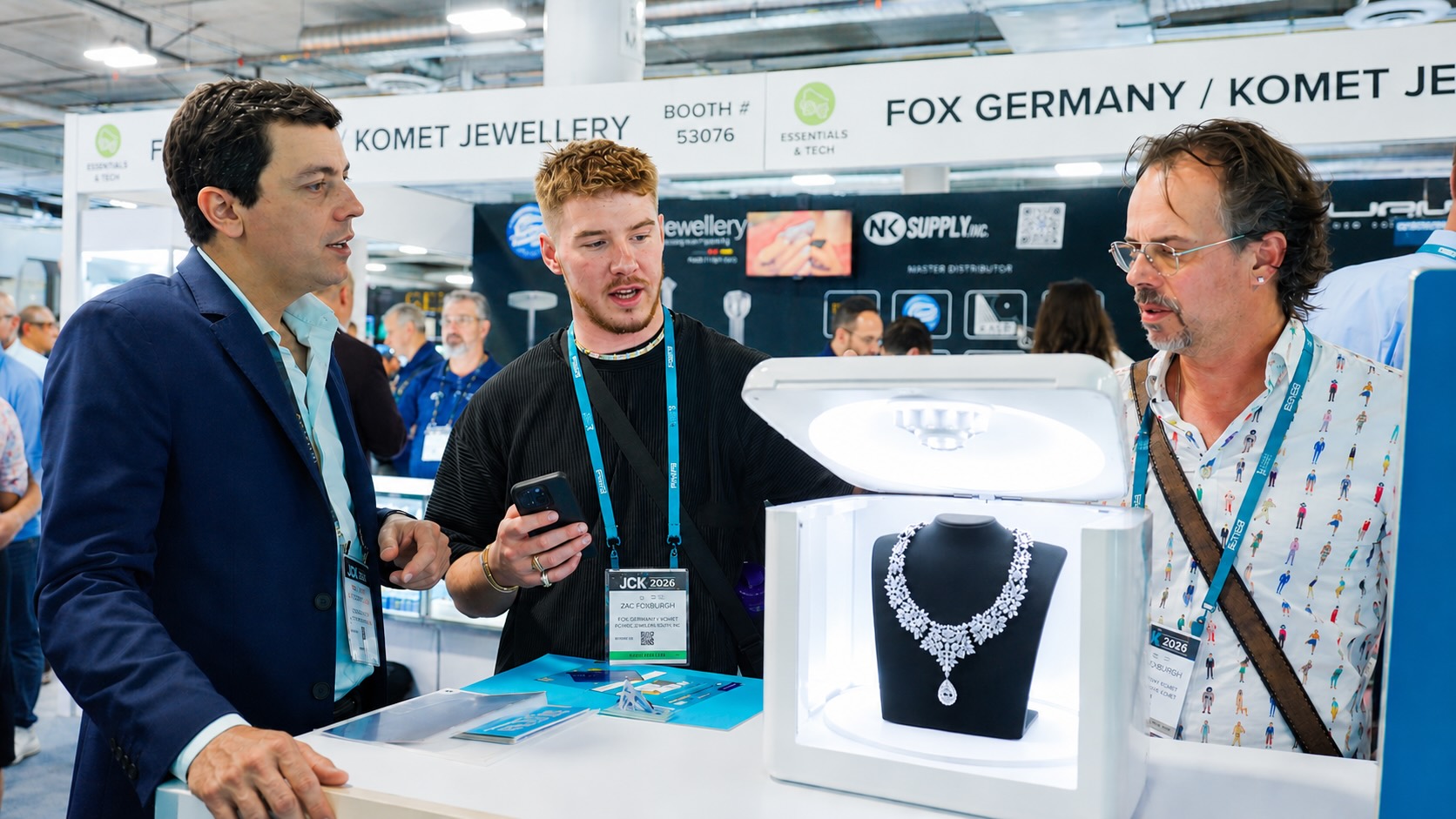
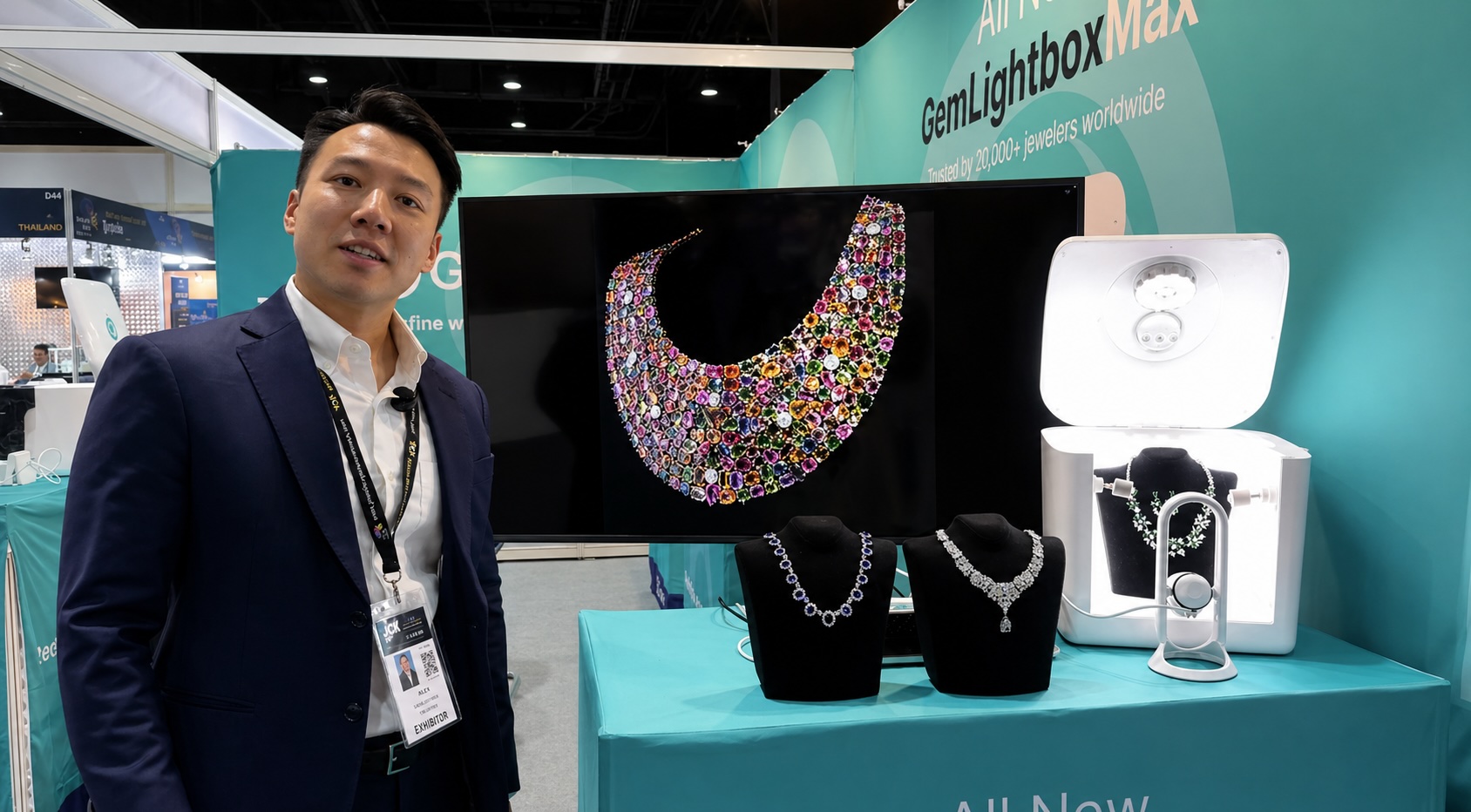
The practical workflow looks like this. Capture the new SKU on a GemLightbox Max with the GemCam Pro. Run it through GemStudio. Generate model shots in three skin tones, lifestyle scenes that match your brand register, and clean catalog versions for the wholesale side. Total turnaround per piece: minutes, not weeks. Total cost per piece: a fraction of a traditional shoot, with no production scheduling.
The remerchandising assortment goes live on your site, in your next email, and on your social channels in the same week the prototypes come back, not three months later. That speed is the entire point.
Move 4: Update the customer-facing story
Pandora made a quiet but smart move recently by listing CO2 impact alongside the 4Cs on every diamond page. It is not about ESG marketing. It is about giving a customer a second reason to buy when the first reason (the price) just got harder.

At $5,000 gold, every retailer needs a second story. The piece costs what it costs. The customer needs to understand why it is worth what it costs. The operators winning right now are the ones telling that story explicitly, not assuming the customer will figure it out.
Options that are working in 2026:
- Sourcing transparency (recycled gold, traceable diamonds, named ateliers)
- Maker visibility (bench moved to the front of the store, video of the actual jeweler making the piece)
- Material education (a one-paragraph explanation of why platinum at this price, why silver in this collection, why lab-grown here and natural there)
- Investment framing (gold’s price trajectory is a sales asset, not a liability, when framed right)
Pick one and run with it across your site, email, and social. The point is not which story you tell. The point is that you tell one, consistently, instead of letting the price tag carry the entire conversation.
What separates the operators with stronger 2026 margins
Gold at $5,000 is a stress test for every operator decision in the business. Pricing discipline. Assortment design. Visual content velocity. Customer story. The jewelers who come out of 2026 with stronger margins than they went in are not the ones who waited for prices to settle. They are the ones who treated each of these four moves as a project with a deadline.
Pull the top 50 SKUs this week. Sketch the six new pieces next week. Capture and publish the new visual story the week after that. Tell the customer story across every channel from then on.
Ninety days. Four moves. A catalog that is built for the market that actually exists.
Sources
- JP Morgan Global Research, A new high? Gold price predictions from J.P. Morgan Global Research — https://www.jpmorgan.com/insights/global-research/commodities/gold-prices
- Reuters via Investing.com, JP Morgan raises gold outlook on investor interest, central bank buying — https://www.investing.com/news/economy-news/factboxjp-morgan-raises-gold-outlook-on-investor-interest-central-bank-buying-4305178
- Pandora Group Press Release, Pandora adds carbon footprint labelling for lab-grown diamonds — https://www.pandoragroup.com/media/press-releases/pandora-adds-carbon-footprint-label-for-lab-grown-diamonds
- Rapaport News, Pandora Claims Its Lab-Grown Carbon Footprint Is 90% Lower Than Natural — https://rapaport.com/news/pandora-claims-its-lab-grown-carbon-footprint-is-90-lower-than-natural/

Leave a Reply