
Table of Contents:
- QVC’s Bankruptcy Is Not a TV Story. It Is a Buyer Story.
- Where Those Buyers Actually Went
- What Discovery Looks Like Now
- The New Purchase Journey Requires a Different Kind of Content Infrastructure
- What Independent Jewelers Can Do That QVC Never Could
- The Channel Has Changed. The Opportunity Has Not.
QVC Group filed for Chapter 11 bankruptcy last April 17, 2026, carrying more than $6.6 billion in debt. The company says it plans to continue operating through restructuring and hopes to emerge within 90 days. Whether it does or not is not the story that matters most for independent jewelry operators.
The story that matters is the buyers.
QVC and HSN collectively moved billions of dollars worth of jewelry over several decades. They built an entire generation of jewelry buyers — people who discovered, researched, and purchased fine jewelry through long-form, broadcaster-led television retail. That model is not struggling because jewelry fell out of favor. It is struggling because those buyers found a better way to do what QVC was doing for them — and moved there.
Understanding where they went is the most commercially useful thing an independent jeweler can take from this moment.
QVC’s Bankruptcy Is Not a TV Story. It Is a Buyer Story.
The model QVC pioneered — showing jewelry at length, explaining the craft, building familiarity and trust before asking for the sale — was never really about television. It was about dwell time. It was about giving a buyer enough visual and informational contact with a piece to feel confident committing to a high-consideration purchase without holding it in their hands.
That need has not gone away. If anything, it has intensified. What has gone away is the captive broadcast audience that QVC depended on to deliver dwell time at scale.
Those buyers did not stop buying jewelry. They stopped watching television. And the channels they moved to have created a new set of requirements for any brand that wants to reach them there.
Where Those Buyers Actually Went
The data on where jewelry buyers now spend their attention is consistent across every major industry source.
Digital channels account for 25 to 30 percent of total jewelry purchases. Mobile commerce now drives over 60 percent of online jewelry transactions. DTC jewelry brands collectively generate $14.7 billion in annual US revenue — a 41 percent increase from 2022 — powered primarily by Instagram and TikTok-driven acquisition rather than traditional wholesale or retail distribution.
28 percent of Gen Z jewelry discovery happens via social platforms. Signet Jewelers, the largest jewelry retailer in North America, now directs more than one quarter of its entire marketing budget to social media — not because social feels modern, but because the data told them that is where their buyers are.
The buyers are not gone. They are on different screens, in different formats, discovered through different means. And the independent jewelers who understand that are the ones building the content infrastructure to reach them there.

What Discovery Looks Like Now
QVC’s dwell time model worked because buyers spent long stretches of time with a single piece — seeing it from multiple angles, hearing its story, understanding its value before the price appeared. That level of sustained visual and informational contact is what converted passive viewers into buyers.
The digital equivalent of that dwell time is not a single product photo. It is a media-rich product presence — multiple images per SKU, lifestyle context, detail close-ups, collections organized for browsing, and catalog-level product information that answers the questions a buyer has before they ask them.
The brands replicating QVC’s conversion model in a digital environment are the ones who have built that kind of presence consistently, across every piece in their range. That is not a creative challenge. It is an operational one.
The New Purchase Journey Requires a Different Kind of Content Infrastructure
The buyer who once watched QVC for forty minutes before deciding to call in an order now discovers a piece on Instagram, researches it on the brand’s website, looks for additional images and context, and decides in a series of micro-sessions across multiple days.
Each of those micro-sessions is a moment where the content either builds enough confidence to keep the buyer moving toward a decision — or fails to, and the buyer drifts toward a brand whose content does a better job.
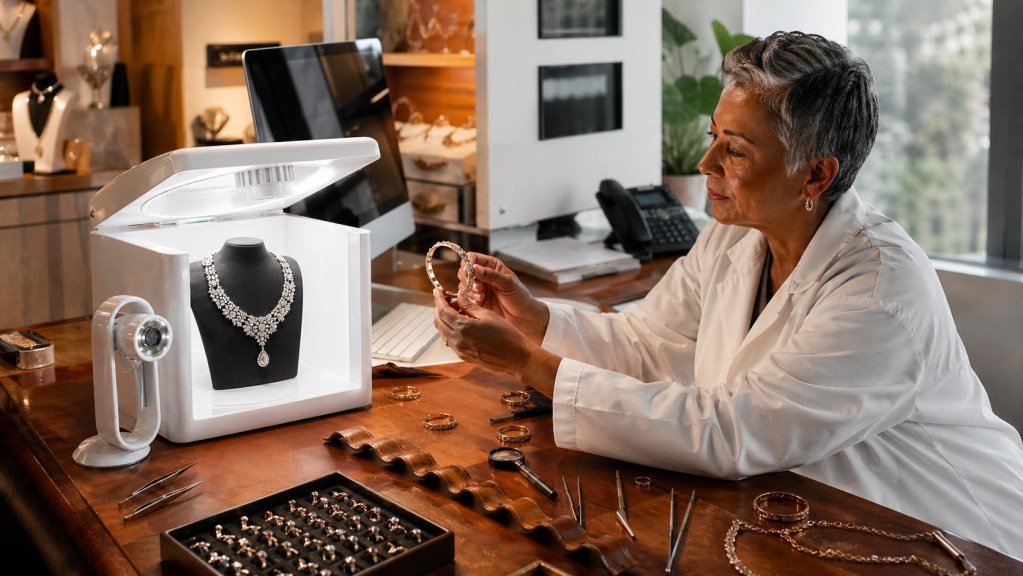
This is the operational reality that GemLightbox Max is built to support. An independent jeweler whose entire catalog is photographed to a consistent, studio-grade standard — every piece showing the same lighting quality, the same level of detail, the same image types across every SKU — is recreating the trust-building conditions that QVC once delivered through broadcast time. The buyer gets sustained, high-quality visual contact with the piece across multiple sessions and multiple channels, all drawing from the same content library.
That consistency is not achievable with a one-off shoot or an ad-hoc photography process. It requires a system.
What Independent Jewelers Can Do That QVC Never Could
Here is what the QVC model could never deliver: specificity.
QVC sold to millions of anonymous viewers simultaneously. An independent jeweler can present a curated, organized catalog of their actual range — SKUs with full product details, collections grouped by theme or occasion, a media gallery that shows each piece from multiple angles — directly to a buyer who has already shown intent.
This is precisely what the GemIQ App enables. It brings together the media gallery, product SKUs and details, and organized collections into a single place — giving independent operators the ability to share a professional, shoppable catalog directly with buyers, wholesale partners, or retail contacts in a format that performs across every channel the buyer currently inhabits.

The buyer who once called QVC’s 1-800 number after forty minutes of television can now receive a direct link to a curated collection, browse it on their phone, see every piece in detail, and make a decision. No broadcast schedule. No passive waiting. The catalog finds the buyer wherever they are.
That is not a capability QVC could ever have built with a TV channel. It is exactly what independent jewelers can build right now.
The Channel Has Changed. The Opportunity Has Not.
QVC’s collapse does not mean the buyers who once purchased through it are gone. It means the channel they used to use has been outcompeted by a better version of the same thing — more personal, more visual, more accessible, and available on the device in their pocket rather than the screen in their living room.
The independent jewelry operators positioned to absorb those buyers are the ones who have built the content infrastructure to meet them in the channels they now use. A catalog photographed to a consistent standard. A media gallery organized for browsing and sharing. Collections that tell a coherent story. Product details that answer every question before the buyer has to ask.
That is the model QVC ran for thirty years on television. It works just as well — better, in fact — when an independent jeweler runs it through a professional imaging system and a digital catalog that can be shared anywhere.

Sources
- National Jeweler — QVC Group Files for Chapter 11 Bankruptcy https://nationaljeweler.com/articles/14888-qvc-group-files-for-chapter-11-bankruptcy
- Philadelphia Inquirer — QVC Group Has Filed for Bankruptcy https://www.inquirer.com/business/retail/qvc-bankruptcy-debt-financial-restructuring-20260417.html
- Retail Dive — QVC Group Follows Through on Bankruptcy, Readies Itself for a New Live-Shopping Era https://www.retaildive.com/news/qvc-group-chapter-11-bankruptcy-live-shopping/817793/
- JCK Online — Looking Back on Jewelry Retail in 2025 and Ahead for 2026 https://www.jckonline.com/article-long/jewelry-retail-in-2025-and-2026/
- Amra and Elma — Top 20 Jewelry Marketing Statistics 2026 https://www.amraandelma.com/jewelry-marketing-statistics/
- Forgecraft — 13 Shocking Online Jewelry Statistics for 2025 https://forgecraftmensjewelry.com/blogs/articles/online-jewelry-statistics
- GemFind — Omnichannel Strategies for Boosting Jewelry Sales in 2026 https://gemfind.com/blogs/digital-marketing/omnichannel-strategies-for-boosting-jewelry-sales-in-2026

Leave a Reply